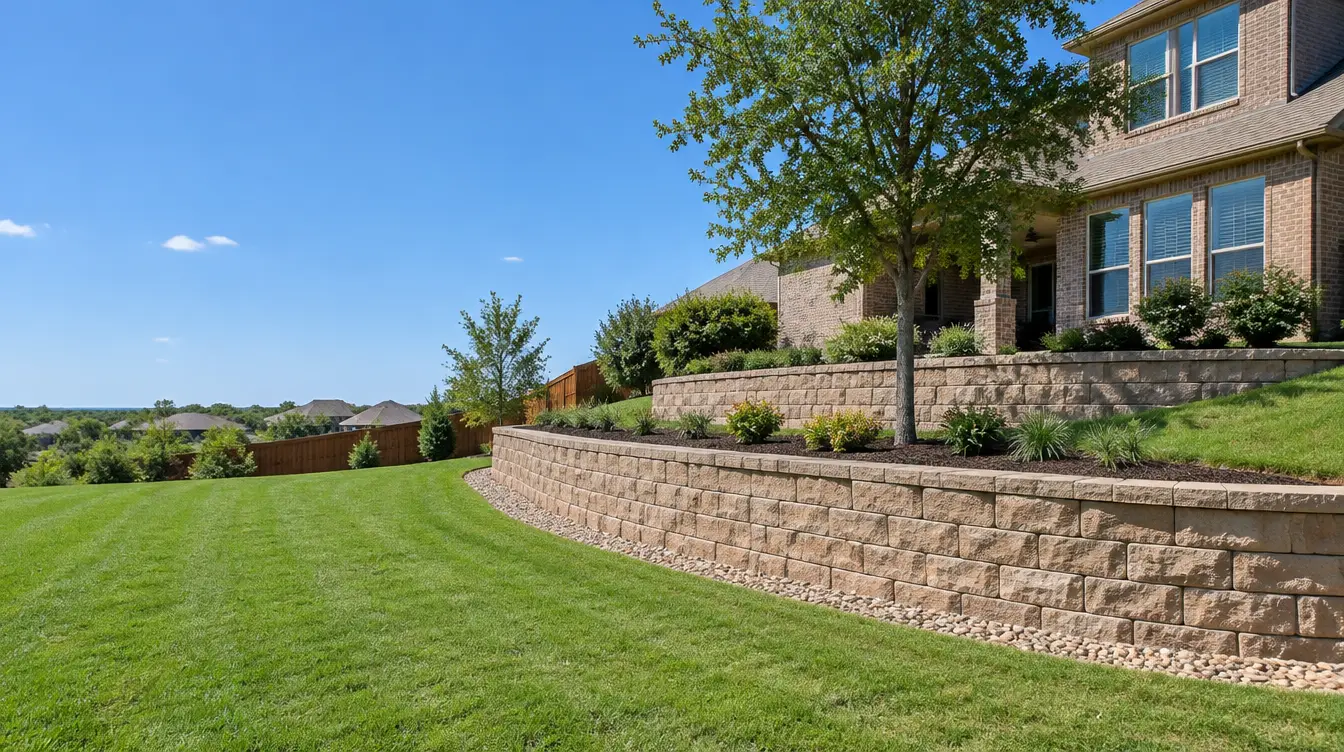
Retaining Walls in Allen’s Creek Greenbelts
Rowlett Creek and Cottonwood Creek both flow through Allen. The city’s greenbelt trails follow four creeks:
- the Rowlett Creek Trail, from McDermott Drive along Rowlett Creek;
- the Cottonwood Trail, along Cotton Creek;
- the Watters Trail, along Watters Creek;
- the Mustang Creek Trail, along Mustang Creek.
We could not find an Allen floodplain page. For a lot that backs onto one of these four greenbelts, the Building and Permitting Division is the office to ask about creek-side rules.
What Allen’s Permit List Leaves Out
Allen publishes its own amended IRC §R105.2 list, “Residential Work Exempt from Permits.” The building list names water tanks, small decks, window awnings, sheds of 120 sq ft or less, poles, temporary pools, and window or door replacement. Retaining walls are not on it.
The city also says it “has recently adopted the 2024 ICC Building Codes effective September 26, 2026.” Plano’s residential code is also a 2024 edition, while Prosper’s retaining wall guidance cites the 2021 IRC and IBC.
In Allen’s fee schedule, last updated June 10, 2026, the retaining wall line sits under Alteration/Minor Modification for single-family, duplex and townhome work.
We found no published engineering height for retaining walls in Allen.
How Allen’s Lots Were Platted
Allen had 1,940 residents in 1970 and 8,314 in 1980, more than four times as many, after rapid growth from the late 1960s. Today it is a Collin County city of 113,447.
Allen’s subdivision records sort residential lots by the decade their plat was filed: 33.7% in the 2000s, 27.9% in the 1990s, 14.1% in the 2010s and 13.0% in the 1980s. That mix runs later than Plano’s, where 27% of platted single-family units date to the 1970s. By build year, 32.9% of homes went up in 2000–2009, 23.3% in 1990–1999, 21.3% in 2010–2019 and 10.3% in 1980–1989.
Together, ZIP codes 75002 and 75013 cover the city’s 26.385 square miles of land.
Keeping Retaining Walls in Allen Draining
Without drainage, hydrostatic pressure builds behind a wall. Habits that help a sound wall include: clean the weep holes yearly, and send downspouts away from the wall. Weep holes are one of three basic drainage parts, along with a perforated pipe at the wall’s base and gravel backfill. A segmental block maker recommends free-draining gravel with virtually no fines, which it calls “wall rock”, under filter fabric that sits below the topsoil.
The retaining wall drainage page explains what sits behind a drained wall, and the retaining wall cost page lists typical prices. Your price is set at the free on-site estimate. Reach us Mon–Sat 8–6, or send the form from your Allen address.