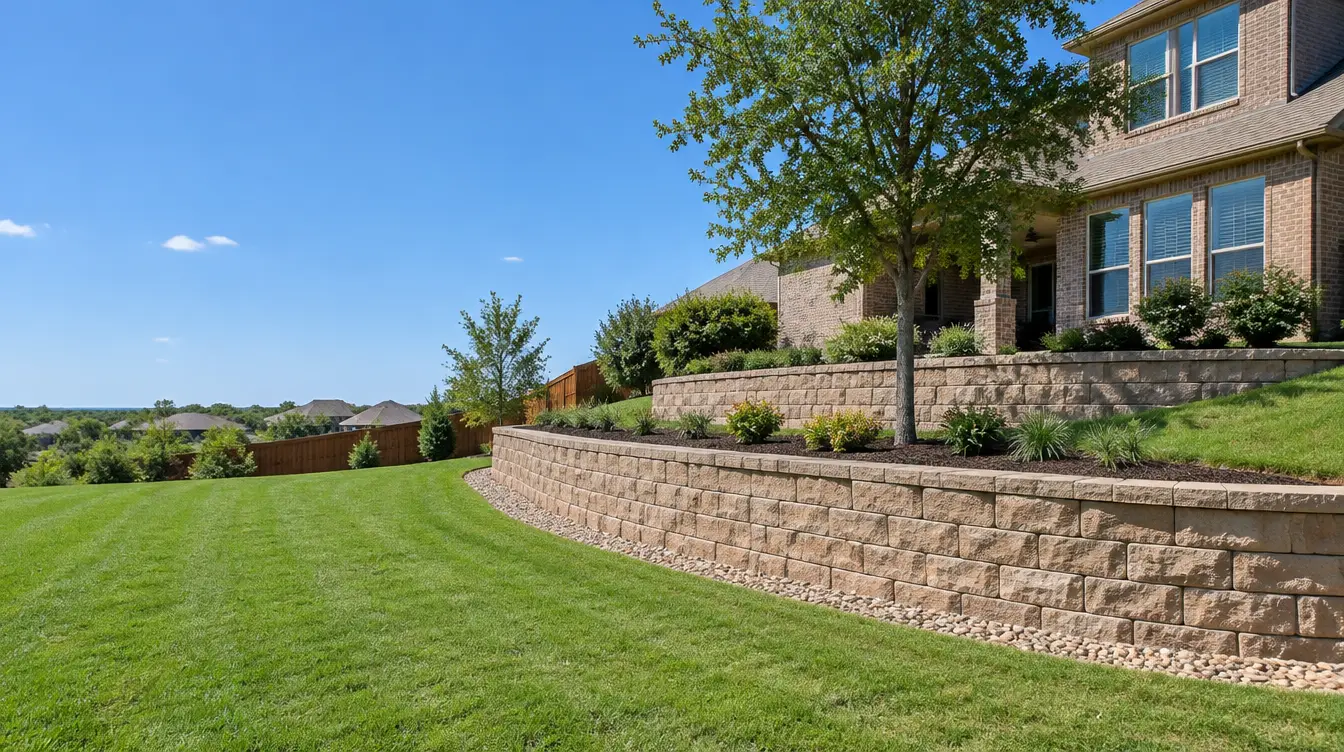
Why Retaining Wall Drainage Matters in Frisco
A retaining wall holds back soil, and the water in that soil pushes too. Without drainage, hydrostatic pressure builds behind a wall and can make it bow, crack or collapse.
The largest soil mapped in Collin County, a clay, takes in water rapidly when it is dry and cracked, and very slowly when it is moist. In dry periods its cracks run 1/2 to 4 inches wide at a foot deep.
May and October are the wettest months at DFW Airport, at 4.78 and 4.37 inches. July and August are the driest, at 2.08 and 2.18 inches. A 10-year storm at Frisco is estimated at 2.49 inches in one hour, and a 100-year storm at 3.57 inches. Over 24 hours, the estimates are 5.98 inches for a 10-year storm and 9.32 inches for a 100-year storm.
If your wall stays wet, seeps through the face or has started to lean, call or send the form. A free on-site estimate checks the drainage first.
What Goes Into Retaining Wall Drainage in Frisco
The diagram below shows a drained block wall. Here is what a drained wall can include, plus one upkeep habit.
Perforated pipe at the base. Basic drainage starts with a perforated pipe at the base of the wall.
Gravel backfill. The zone behind the wall is backfilled with gravel.
Free-draining gravel. A segmental block maker recommends free-draining gravel with virtually no fines, which it calls “wall rock”.
Filter fabric. The same maker recommends filter fabric above the wall rock and below the topsoil.
Weep holes. Weep holes complete basic drainage. Pipes, gravel, weep holes and criblock designs are all ways to drain a wall.
Downspouts. This one is a habit, not a part: send downspouts away from the wall.
Call or send the form, and we will check which of these your wall has.
Adding Drainage Behind an Existing Retaining Wall in Frisco
If a wall was built without drainage, adding it is its own job. Fixing a wall that does not drain runs $60 to $70 per linear foot, done by excavating behind the wall.
If the wall is already failing, the job may become a repair, at $250 to $1,250 per job, or a full remove and rebuild, at $6,000 to $14,500. The retaining wall repair page covers both.
You will know which one you are looking at after the free on-site estimate. Call or send the form.
Frisco Rules on Retaining Walls and Drainage
Frisco’s code has several drainage rules that touch walls and fences. No part of a retaining wall may interfere with or alter a drainage swale between lots. A fence shall not adversely affect drainage, and fences are not permitted in FEMA-designated floodway areas.
The city also requires that no portion of any residential lot be in the 100-year floodplain, and altering or filling floodplain needs a flood study. Frisco keeps watershed studies for Cottonwood Branch, Panther Creek, West Rowlett Creek, Rowlett Creek, White Rock Creek and Stewart Creek, and the Cottonwood Creek Greenbelt runs 77 acres.
For the wall itself, no permit is required for a masonry retaining wall less than 24 inches tall, and a retaining wall taller than 36 inches must follow a design submitted by a registered engineer. The permit fee is $150 per wall, and it doubles if work starts before the permit is obtained. Check with Development Services, Building Inspections before you build. Contractors need a valid Frisco contractor registration and a permit to work in the city.
Keeping Retaining Wall Drainage in Frisco Working
Habits that help a sound wall include:
- clean the weep holes yearly;
- keep downspouts pointed away from the wall.
Between those, watch for signs of trouble such as leaning or bowing, leaking or seeping, cracking, efflorescence and foundation shifting. If one shows up, call us. We answer Mon–Sat 8–6.
What the Free On-Site Estimate Checks
On a drainage visit, we look at:
- whether the wall has a pipe, gravel or weep holes, and whether water is getting out;
- where roof and yard water reach the wall;
- swales between lots and any creek or greenbelt nearby;
- the height and condition of the wall;
- room to excavate behind it, since tight or difficult sites need more manual labor;
- the soil, since clay-heavy soil can raise excavation labor by up to 50%.
Your price is set at the free on-site estimate. Call or send the form to set it up.
