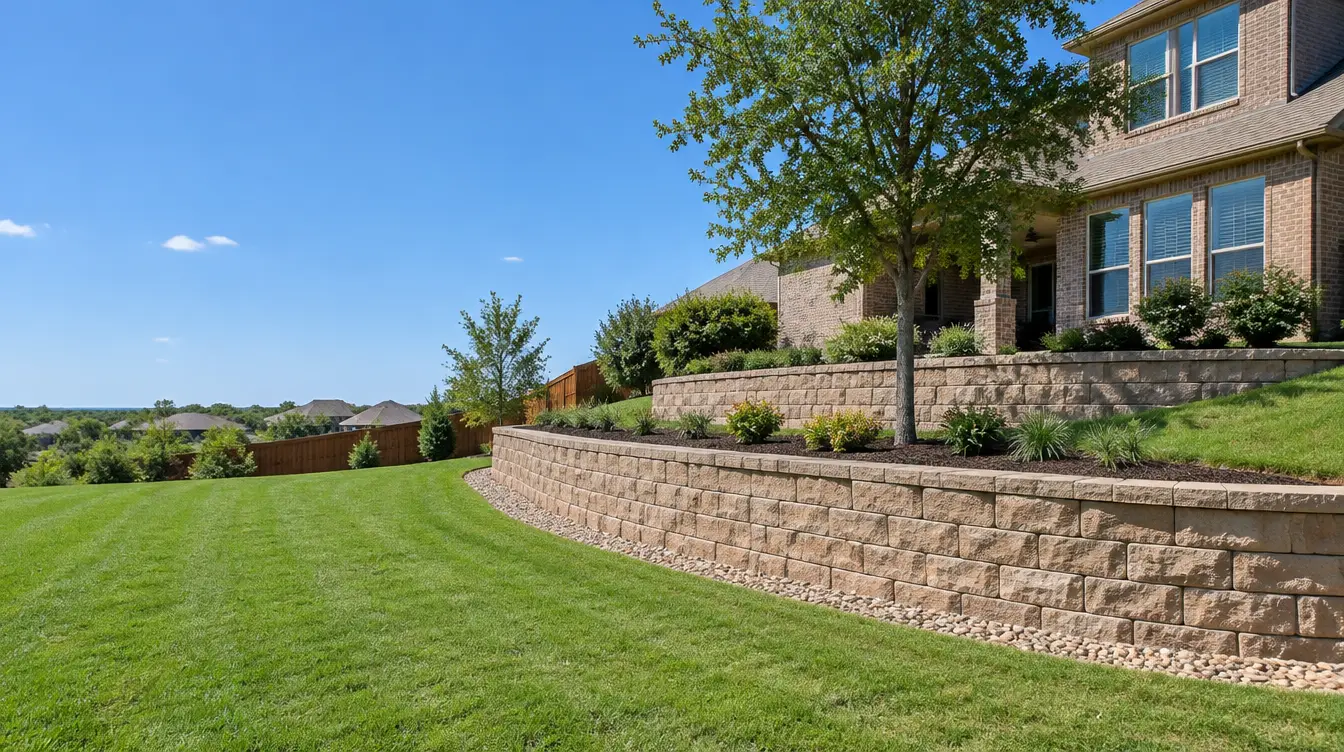
Why Frisco Yards Need Retaining Walls
Frisco’s code defines a retaining wall as “a wall not laterally supported at the top that resists lateral soil loads and other imposed loads.” In plain terms, a retaining wall holds soil on a slope. In a yard that steps down from the street, drops toward a creek greenbelt or sits higher than the lot next door, a wall can turn a slope into level ground you can use.
Frisco has 236,955 residents, spread across both Collin County and Denton County. Its 80,353 housing units have a median build year of 2009. 40.0% were built in 2010–2019, 34.8% in 2000–2009, 13.7% in 1990–1999 and 6.7% in 2020 or later. 69.3% of the units are single detached homes, each with a yard of its own.
Frisco keeps watershed studies for Cottonwood Branch, Panther Creek, West Rowlett Creek, Rowlett Creek, White Rock Creek and Stewart Creek. The Caddo Trail follows Stewart Creek south of Stonebrook Parkway, and the Cottonwood Creek Greenbelt is a 77-acre park with a 1.94-mile trail.
The city requires “that no portion of any residential lot be included in the 100-year floodplain,” and altering or filling floodplain needs a flood study.
If your yard has a slope, a washout or an old wall that has started to lean, call us or send the form. We answer Mon–Sat 8–6 and set up a free on-site estimate.
Retaining Wall Types We Build in Frisco
There is no single best wall. The right one depends on the height, the look you want, the budget and the water that moves through that part of the yard. Here is how the main types compare.
Block walls. Segmental walls stack interlocking blocks without mortar. They allow slight ground movement and handle 3 to 4 feet without added reinforcement. Depending on the project, a block wall runs $15 to $50 per square foot of wall face, installed. Read more on the block retaining walls page.
Natural stone walls. Stone walls last 40 to 200 years. Stone also has the widest price range of any wall type: $20 to $100 per square foot installed. See the stone retaining walls page.
Timber walls. Wood has the lowest price range, $13 to $30 per square foot installed, and the shortest life: 10 to 40 years, with pressure-treated wood around 30. Railroad ties are creosote-treated wood, the creosote is toxic, and ties are rarely used now for that reason. The timber retaining walls page has the details.
Concrete walls. Cantilevered walls use reinforced concrete with an L-shaped footing and suit walls over 4 feet. Gravity walls rely on their mass. Concrete walls last 50 to 100 years, and poured concrete runs $20 to $40 per square foot installed. The retaining wall cost page compares every type.
Repair and drainage. Not every job is a new wall. Repair work includes leaning or bowing, leaking or seeping, cracking, efflorescence and foundation shifting; see retaining wall repair. Adding drainage behind an existing wall that does not drain is its own job; see retaining wall drainage.
Not sure which type fits your yard? That is what the free on-site estimate is for. Call or send the form and we will look at the slope with you.
What Retaining Walls Cost in Frisco
Depending on the project, a retaining wall runs from $13 to $100 per square foot of wall face, installed. Where your wall lands in that range comes down to the material, the height and the site. Here is how each wall type and service typically prices out:
- Block (segmental): $15 to $50 per sq ft of wall face, installed.
- Natural stone or boulder: $20 to $100 per sq ft, installed.
- Timber: $13 to $30 per sq ft, installed.
- Poured concrete: $20 to $40 per sq ft, installed.
- Repair: $250 to $1,250 per job.
- Drainage added behind an existing wall: $60 to $70 per linear ft.
- Engineering design: $500 to $750 per wall.
A typical complete retaining wall project runs about $3,200 to $9,400.
These things move the price:
- the height of the wall;
- the material;
- the length;
- access, since tight or difficult sites need more manual labor;
- slope, since sloped yards may need terracing, which can add 50% or more;
- soil, since clay-heavy soil can raise excavation labor by up to 50%;
- drainage;
- removing an old wall, which runs $15 to $30 per linear foot.
If your wall needs a city permit, Frisco charges $150 per wall. Your price is set at the free on-site estimate. The retaining wall cost page has the full breakdown, or call or send the form for your own number.
Retaining Wall Permits and Engineering in Frisco
Frisco handles retaining wall permits through Development Services, Building Inspections. The city says a permit is required for any commercial, residential, sign, fence or other miscellaneous structure. Its fence and retaining wall rules sit in Chapter 18, Article IX of the Code of Ordinances.
Here is what that code publishes for retaining walls:
- No permit is required for a masonry retaining wall less than 24 inches tall. Ask the city whether your wall counts as masonry.
- A retaining wall taller than 36 inches must follow a design submitted by a registered engineer.
- No part of a retaining wall may interfere with or alter a drainage swale between lots.
- Fence posts attached to or supported by a retaining wall need foundation and anchorage that keep the wall from moving.
- Where a wall raises a fence, the fence height is measured from the ground at the highest point.
- The permit fee is $150 per wall, or $300 per subdivision, and the fee doubles if work starts before the permit is obtained.
- Contractors need a valid Frisco contractor registration and a permit to work in the city.
At the state level, the Texas engineering statute’s exemption for plans for private dwellings and the structures that go with them does not mention retaining walls. The engineering line that applies to a Frisco yard is the city’s: 36 inches.
Permit rules change, so confirm the current version with Building Inspections before building. During the free on-site estimate we measure the wall height these rules depend on.
North Texas Clay and Retaining Walls in Frisco
Houston Black clay is the largest soil mapped in Collin County, about 210,000 of 567,142 mapped acres. It has high shrink-swell potential, with cracks 1/2 to 4 inches wide at 12 inches deep during dry periods, and those cracks stay open 90 to 150 cumulative days in most years. Water enters it rapidly when it is dry and cracked, and very slowly when it is moist.
Frisco also reaches into Denton County, where the largest mapped soil components are Sanger, Somervell, Callisburg, Gasil and Ponder, not Houston Black. That is one reason the free on-site estimate checks the soil along the wall line.
DFW Airport averages 37.01 inches of rain a year. May (4.78 inches) and October (4.37 inches) are the wettest months, and July and August are the driest. A 10-year storm at Frisco is estimated at 2.49 inches in one hour, and a 100-year storm at 9.32 inches in 24 hours.
Clay soil can be very problematic for retaining walls. Walls built on clay often need extra reinforcement, and clay-heavy soil can raise excavation labor by up to 50%.
Without drainage, hydrostatic pressure builds behind a wall and can make it bow, crack or collapse.
Basic drainage is a perforated pipe at the base of the wall, gravel backfill and weep holes. Criblock designs are another drainage option. A segmental block maker recommends free-draining gravel with virtually no fines, which it calls “wall rock”. It also recommends filter fabric above that gravel and below the topsoil. The diagram below shows those layers in place.
Once a wall is built, clean the weep holes yearly and send downspouts away from the wall. If you are not sure your wall has drainage at all, call us and we will check during a free on-site estimate.
Signs Your Retaining Wall in Frisco Is Failing
Signs of retaining wall trouble include:
- leaning or bowing;
- leaking or seeping;
- cracking;
- efflorescence;
- foundation shifting.
Causes include water pressure behind a wall with no drainage, footings that lack strength and missing rebar. The leaning retaining wall page explains each one.
Sometimes the trouble is a slope with no wall at all. A retaining wall holds soil on a slope, and sloped yards may need terracing. The sloped yard erosion page covers that job.
If you see any of these signs, call or send the form, and we will set a time to look at the wall in person.
Retaining Walls Beyond Frisco: Plano, McKinney, Allen and Prosper
We also answer calls and give free on-site estimates in the four cities around Frisco. Each sets its own retaining wall rules, so each has its own page.
- Plano: homes here have a median build year of 1993, and about 82% of platted single-family detached units were platted between 1970 and 1999.
- McKinney: the Collin County seat, with a median build year of 2007, where the city requires a permit for any retaining wall regardless of height.
- Allen: Rowlett Creek and Cottonwood Creek flow through the city, whose homes have a median build year of 2003.
- Prosper: homes have a median build year of 2014, and 52.0% were built in 2010–2019.
Wherever your yard is, the first step is the same: call us or send the form, and we will set up your free on-site estimate.
